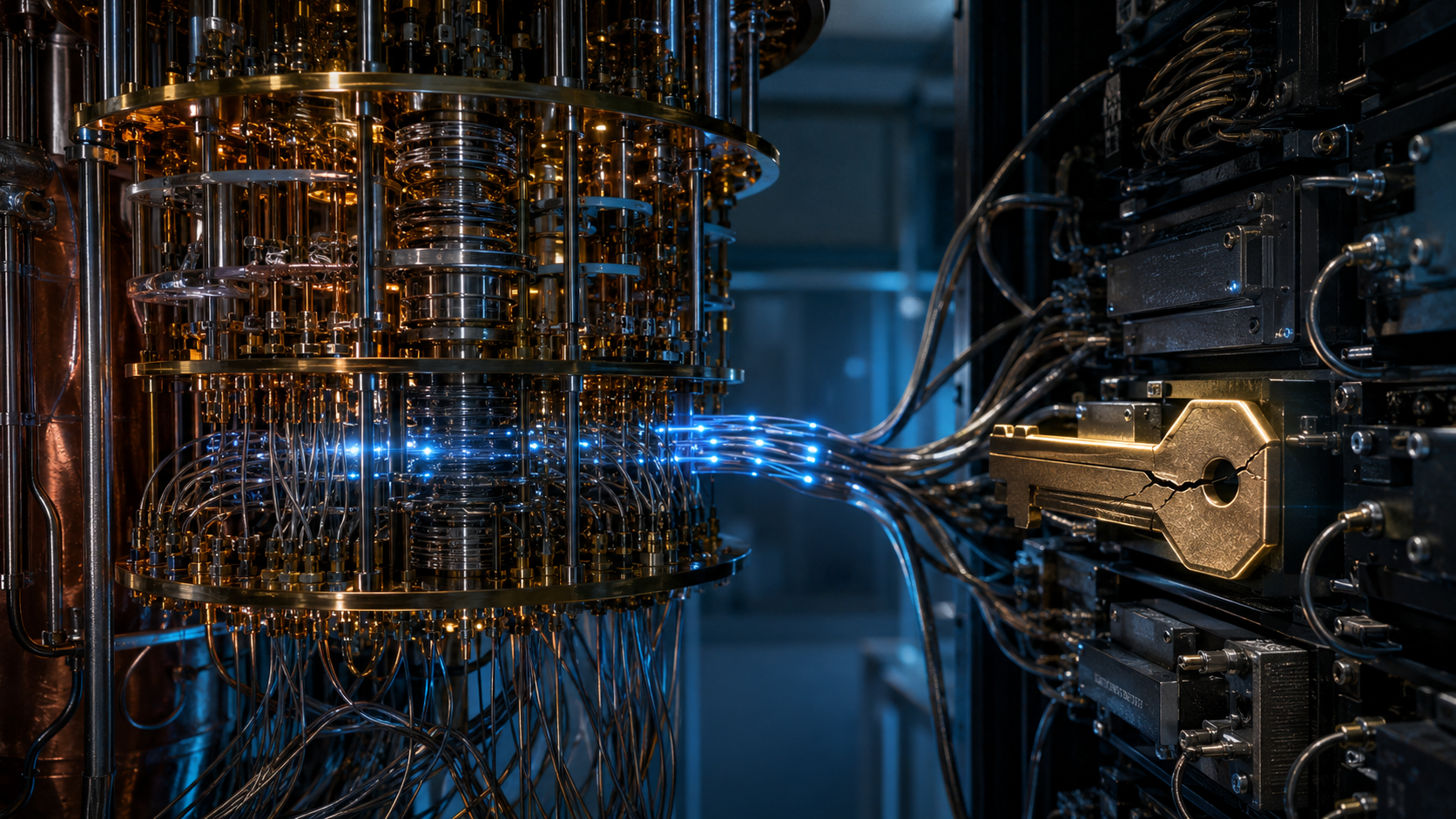
AI Is Speeding Up the Quantum Threat. Defense Still Has a Coordination Problem
When Google Quantum AI reported in July that it had taught a quantum computer to “learn from its errors,” the obvious story was better error correction. Quantum computers are extremely sensitive machines. Small changes in their environment can push them out of tune and introduce errors, which can force researchers to stop a calculation and recalibrate the hardware. Google’s AI system learned to make some of those adjustments while the machine was still running. In tests, it made the system 3.5… [...]
Rating
Innovation
Pricing
Technology
Usability
We have discovered similar tools to what you are looking for. Check out our suggestions for similar AI tools.


Google says it made a breakthrough toward practical quantum computing
Enabled by the introduction of its Willow quantum chip last year, Google today claims it's conducted breakthrough research that confirms it can create real-world applications for quantum computer [...]
Research shows ‘more agents’ isn’t a reliable path to better enterprise AI systems
Researchers at Google and MIT have conducted a comprehensive analysis of agentic systems and the dynamics between the number of agents, coordination structure, model capability, and task properties. W [...]
Nvidia's agentic AI stack is the first major platform to ship with security at launch, but governance gaps remain
For the first time on a major AI platform release, security shipped at launch — not bolted on 18 months later. At Nvidia GTC this week, five security vendors announced protection for Nvidia's a [...]
The 11 runtime attacks breaking AI security — and how CISOs are stopping them or can stop them
Enterprise security teams are losing ground to AI-enabled attacks — not because defenses are weak, but because the threat model has shifted. As AI agents move into production, attackers are exploiti [...]
MCP solved tool calling. A2A solved coordination. What solves transport?
The history of distributed computing is one of protocol proliferation followed by consolidation. Common Object Request Broker Architecture (CORBA), Distributed Component Object Model (DCOM), Java remo [...]
How Anthropic's Claude cuts SOC investigation time from 5 hours to 7 minutes
Integrating AI models directly into extended detection and response (XDR) platforms is delivering breakthrough improvements in SOC investigation speed and accuracy.In an exclusive interview with Ventu [...]
Google's Michel Devoret is one of the 2025 winners of the Nobel Prize in Physics
The Royal Swedish Academy of Sciences has awarded Google's Chief Scientist of Quantum Hardware the Nobel Prize in Physics alongside former Google employee John Martinis, and University of Califor [...]