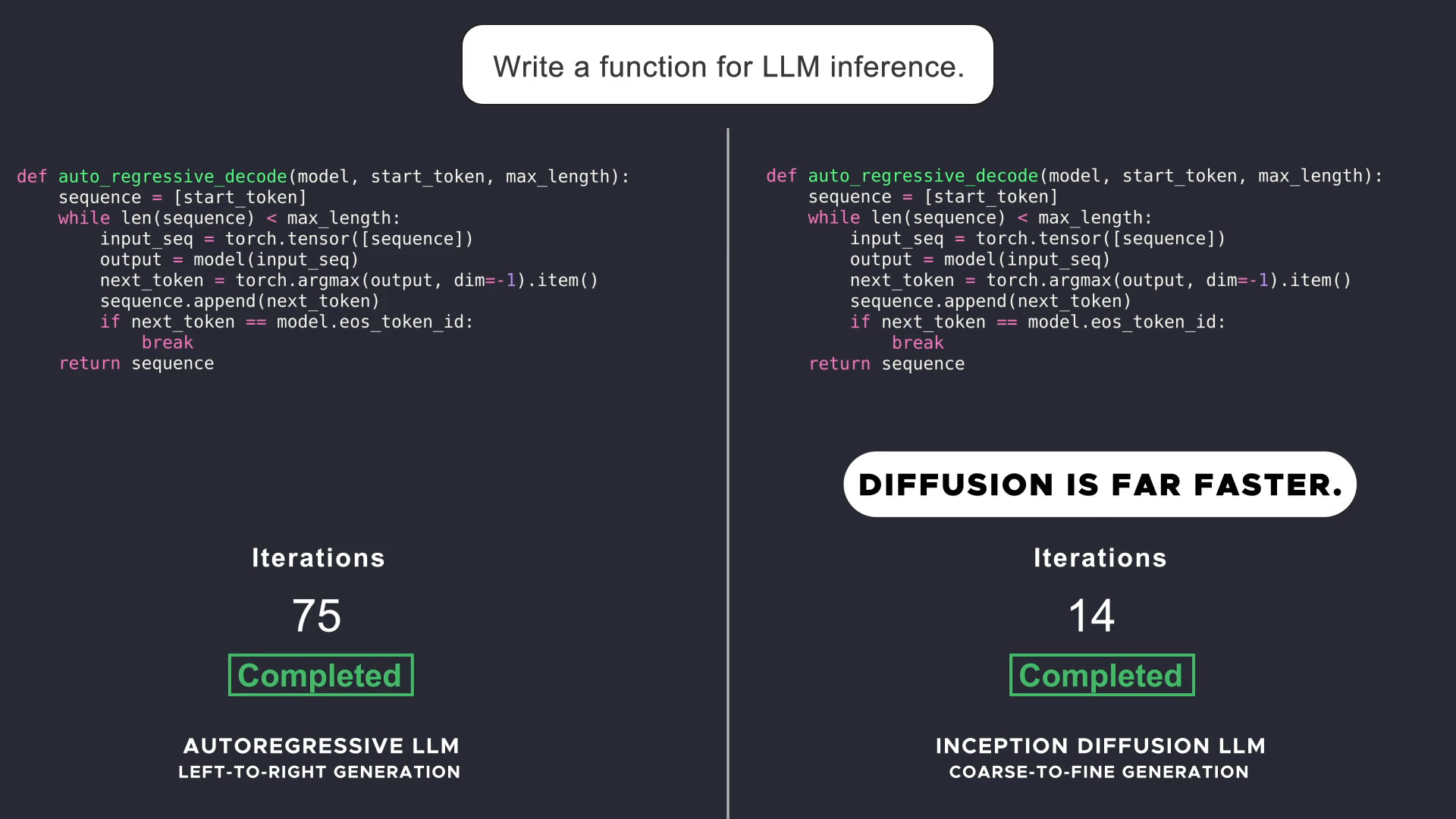
Inception Labs introduces its Mercury Series of diffusion-based LLMs
Inception Labs has introduced Mercury, a new series of large language models that use diffusion technology rather than traditional autoregressive processing. The company reports these models can process tasks 10 times faster than current approaches, with initial releases focused on coding applications.<br /> The article Inception Labs introduces its Mercury Series of diffusion-based LLMs appeared first on THE DECODER. [...]
Rating
Innovation
Pricing
Technology
Usability
We have discovered similar tools to what you are looking for. Check out our suggestions for similar AI tools.

Inception launches Mercury 2, the first diffusion-based language reasoning model
Mercury 2 from Inception is the first diffusion-based reasoning model. Instead of generating text word by word, it refines entire passages in parallel, making it more than five times faster than conve [...]
NYU’s new AI architecture makes high-quality image generation faster and cheaper
Researchers at New York University have developed a new architecture for diffusion models that improves the semantic representation of the images they generate. “Diffusion Transformer with Represent [...]
Google's DiffusionGemma generates 256 tokens in parallel and self-corrects as it goes
GenAI image generators like Stable Diffusion do not draw a picture pixel by pixel from left to right. They start with noise and iteratively refine the entire image in parallel until it converges, in a [...]

Inception raises $50 million to bring fast, affordable diffusion models to text and code
AI start-up Inception just secured $50 million in fresh capital. The round was led by Menlo Ventures, with backing from Microsoft’s M12, Nvidia, Databricks, and Snowflake.<br /> The article In [...]
Black Forest Labs launches Flux.2 AI image models to challenge Nano Banana Pro and Midjourney
It's not just Google's Gemini 3, Nano Banana Pro, and Anthropic's Claude Opus 4.5 we have to be thankful for this year around the Thanksgiving holiday here in the U.S.No, today the Germ [...]
Inception's comeback brings new funding and a shift to diffusion models
Inception is back in the AI race with $50 million in new funding and a bold bet on diffusion models for text and code. Its new Mercury model promises to outpace and undercut traditional LLMs on both s [...]
Z.ai's open source GLM-Image beats Google's Nano Banana Pro at complex text rendering, but not aesthetics
The two big stories of AI in 2026 so far have been the incredible rise in usage and praise for Anthropic's Claude Code and a similar huge boost in user adoption for Google's Gemini 3 AI mode [...]
Endor Labs launches free tool AURI after study finds only 10% of AI-generated code is secure
Endor Labs, the application security startup backed by more than $208 million in venture funding, today launched AURI, a platform that embeds real-time security intelligence directly into the AI codin [...]
Apple Watch Series 11 review: A reliable wearable for when it matters most
The tenth generation of the Apple Watch came and went without much fanfare last year, and the arrival of the Series 11 is similarly subdued. Not much appears to have changed with Apple’s smartwatch, [...]