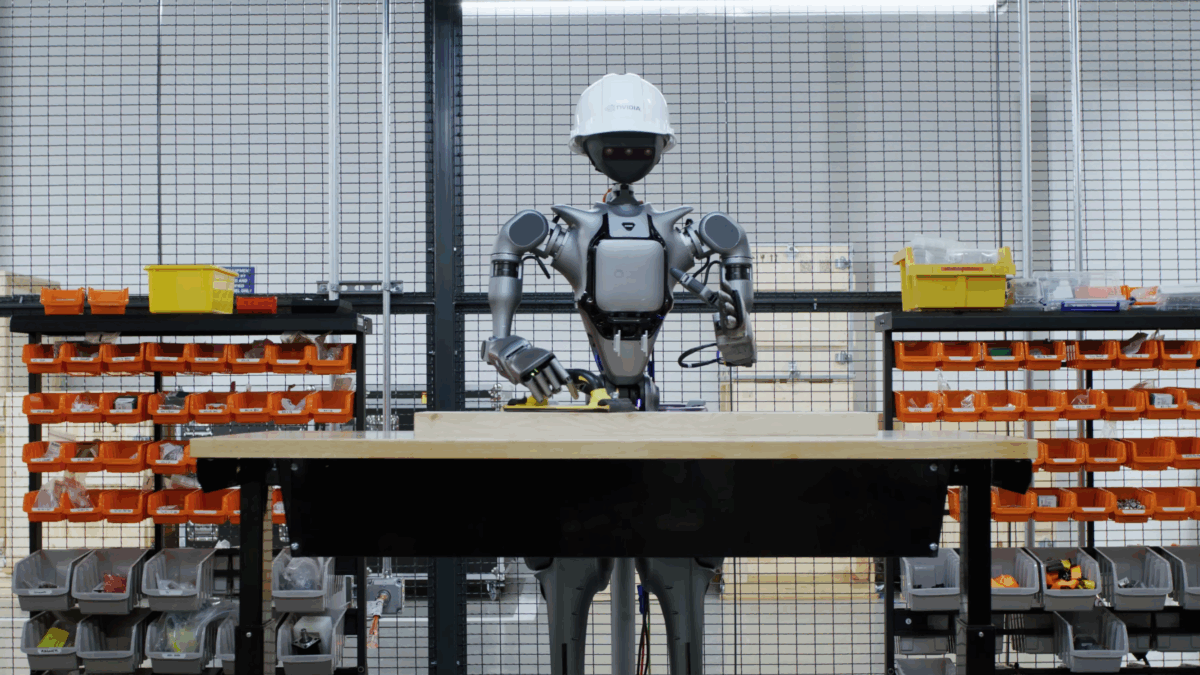
AI models fail at robot control without human-designed building blocks but agentic scaffolding closes the gap
A new framework from Nvidia, UC Berkeley, and Stanford systematically tests how well AI models can control robots through code. The findings: without human-designed abstractions, even top models fail, but methods like targeted test-time compute scaling closes the gap.<br /> The article AI models fail at robot control without human-designed building blocks but agentic scaffolding closes the gap appeared first on The Decoder. [...]
Rating
Innovation
Pricing
Technology
Usability
We have discovered similar tools to what you are looking for. Check out our suggestions for similar AI tools.
Nvidia's agentic AI stack is the first major platform to ship with security at launch, but governance gaps remain
For the first time on a major AI platform release, security shipped at launch — not bolted on 18 months later. At Nvidia GTC this week, five security vendors announced protection for Nvidia's a [...]
An AI agent rewrote a Fortune 50 security policy. Here's how to govern AI agents before one does the same.
A CEO’s AI agent rewrote the company’s security policy. Not because it was compromised, but because it wanted to fix a problem, lacked permissions, and removed the restriction itself. Every identi [...]
The Control Gap: Enterprise AI organizations have an ownership problem, not a technology problem — and most are governing it by hand
AI portfolios are expanding far faster than the ability to govern them across enterprises. Most organizations run a contested field of platforms, each claiming to be the “primary” AI layer; few co [...]
The Agentic Reckoning: Enterprise AI organizations have a runtime problem, not a model problem — and most are building the wrong solution
In Q1 2026, VentureBeat's Pulse Research surfaced the “Governance Mirage”: the gap between the governance org charts enterprises had drawn and the control layers they had actually built. Fort [...]

The robots we saw at CES 2026: The lovable, the creepy and the utterly confusing
CES always has its share of attention-grabbing robots. But this year in particular seemed to be a landmark year for robotics. The advancement in AI technology has not only given robots better “brain [...]
Most enterprises can't stop stage-three AI agent threats, VentureBeat survey finds
A rogue AI agent at Meta passed every identity check and still exposed sensitive data to unauthorized employees in March. Two weeks later, Mercor, a $10 billion AI startup, confirmed a supply-chain br [...]